About Shakopee Water Damage Restoration
24/7 water damage restoration for Shakopee, MN and the nearby Minnesota River valley, water and sewage only. The restoration team extracts standing water, dries the structure to the IICRC S500 standard and documents every step for the insurance claim.
Built around how water gets into homes here
Shakopee is the seat of Scott County, on the south bank of the Minnesota River. The oldest homes sit near downtown and First Avenue, some more than a century old on stone or block foundations. Most of the city went up from the 1990s on, as the population climbed from about 11,700 in 1990 to more than 43,000 by 2020: split-levels, two-stories and townhomes with finished lower levels, drain tile and a sump pit.
That mix sets the list. A sump pump that quits in a spring thaw floods a finished basement in an hour or two. A January cold snap splits pipes on outside walls and builds ice dams on the eaves. Thunderstorms overload drains and window wells, and in high-water years the river itself rises into the low ground near Huber Park and Memorial Park. The walkthrough checks the sump pit, the rim joists and the ceiling below, not just the room where water showed up.
What gets handled
Water and sewage only: water extraction, basement flooding, sump pump failures, sewage backups, snowmelt seepage, river and flash flooding, frozen pipes, burst pipes, ice dams, ceiling, water heater and appliance leaks, structural drying and commercial losses.
Find us on Google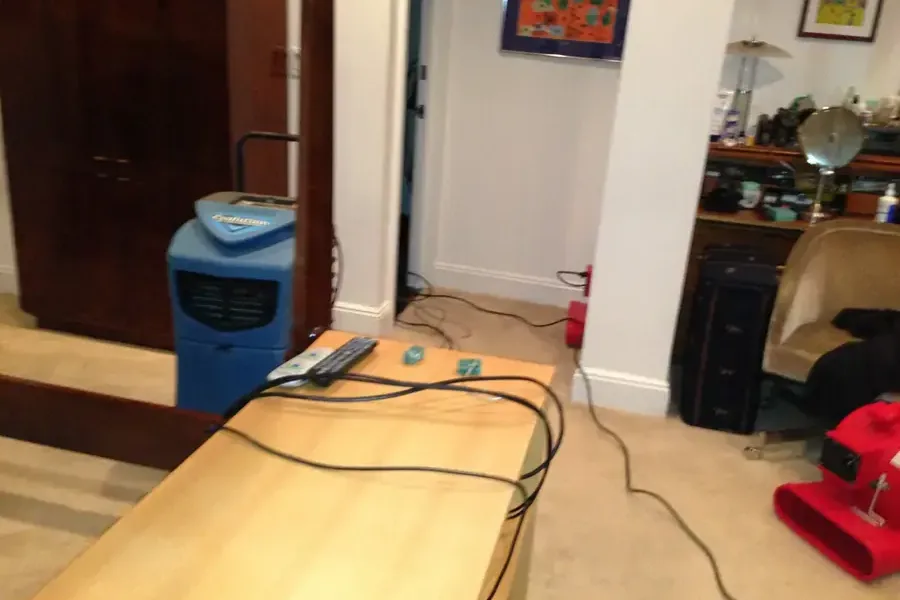
What every dry-out is held to
Rapid local response
Active water is treated as urgent at any hour, holidays and January nights included, because a basement keeps soaking until the water is pulled.
IICRC S500 drying standard
Structural drying, not just surface drying, with air movers and LGR dehumidifiers sized to the class of the loss.
Claim-ready documentation
Moisture maps, daily psychrometric logs and timestamped photos taken before anything is removed.
River valley know-how
Sump pits, finished lower levels, frozen pipes, ice dams and spring thaw seepage are the everyday work here.
The working vocabulary of a real dry-out
- IICRC S500 is the industry drying standard.
- Category 1, 2 and 3 water are handled differently.
- Class 1 through 4 sets how much equipment a room needs.
- Porous materials touched by Category 3 water are removed, not dried.
- Equipment stays until the readings say dry, not until it looks dry.
- Daily moisture readings and drying logs go into the claim file.
Water where it should not be?
Extraction, structural drying and claim documentation around the clock, from downtown to Southbridge and across the river valley.