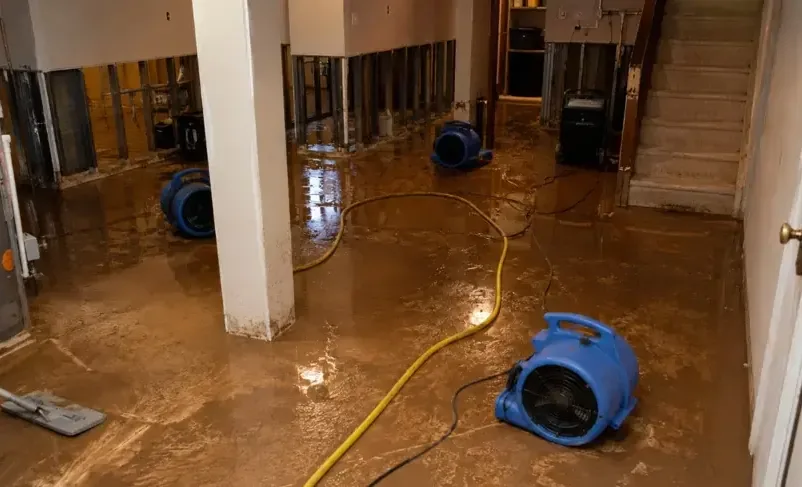
Finished lower levels

Basement Flooding Cleanup in Shakopee, MN

A flooded lower level is rarely just concrete. The restoration crew pumps it out, pulls wet carpet, pad and lower drywall, and dries the framing and poured walls behind the finishes to the IICRC S500 goal.

(888) 432-4933Basement under water? Get the pump-out started
Pump-out and extraction Flood cuts above the wet zone Daily moisture logs
Standing water spread across the floor of a finished basement
Water category1 to 3, by source
Class of lossOften 2 or 3
Typical drying3 to 6 days
Drying standardIICRC S500
Right now

First steps for basement flooding cleanup

  1. Find the source

    Check the sump pit, floor drain and utility room to see where water is coming from.

  2. Shut off power

    Kill lower-level circuits only if the panel is dry and reachable.

  3. Save the valuables

    Move photos, papers and electronics upstairs.

  4. Stay out of drain water

    If it came up the floor drain, treat it as sewage.

Trade facts
Common sourcesSump pit, seepage, pipes, drains
Usual removalPad, lower drywall, wet insulation
EquipmentPumps, LGR, air movers, heat
Drying goal2 to 4 points of a dry reference
The standard

How basement flooding cleanup is held to the drying standard

Rapid local response

Active water is treated as urgent at any hour, because it keeps wicking into drywall, pad and framing after dark.

IICRC S500 drying standard

Structural drying, not just surface drying, with equipment sized to the class of the loss.

Claim-ready documentation

A moisture map, daily psychrometric readings and timestamped photos taken before any demolition.

Cold-climate know-how

Basements, frozen pipes, ice dams and spring thaw water are everyday work in the Minnesota River valley.

Typical cost ranges

What does basement flooding cleanup cost in Shakopee, MN?

In Shakopee, MN, basement flooding cleanup typically runs $2,500 to $12,000: an unfinished basement with clean water sits at the low end, and a fully finished lower level soaked by contaminated water sits at the high end.

Unfinished or partly finished

$2,500 to $4,500
  • Pump-out and extraction
  • Concrete and wall drying
  • Daily readings

Finished lower level

$4,500 to $8,500
  • Carpet, pad and flood cuts
  • Insulation out on outside walls
  • Framing dried

Contaminated or whole level

$8,500 to $12,000+
  • Category 3 removal
  • Containment and antimicrobial
  • Extended drying

Ranges are typical, not a quote. The water category, the square footage that got wet, the material class and how fast drying started move the number most. For a planning range, run the water damage cost calculator.

The process

The basement flooding cleanup process, in order

The order matters: moisture mapping comes before equipment, and equipment stays until the readings say dry, not until it looks dry.

  1. 01

    Pump and extract

    Standing water out first, then the carpet and pad.

  2. 02

    Open the walls

    Flood cuts above the wet reading and wet insulation removed.

  3. 03

    Dry and heat

    LGR dehumidifiers, air movers and heat for the cold slab.

  4. 04

    Verify and log

    Readings every day until the walls match a dry reference.

Most basements in the city are finished: a carpeted family room, a bedroom or two, a bath and a utility room, all below grade on drain tile. When water gets in, from a sump pit, a pipe, a window well or a drain, it spreads under the carpet and climbs the drywall before anyone sees it.

Finding the source before the cleanup

The source decides the category. A burst pipe or a water heater is clean water; a sump pit overflow is usually Category 2; a floor drain backup or river water is Category 3. The tech who does the walkthrough checks the pit, the floor drain, the window wells and the walls on the uphill side before the cleanup plan is set.

  • Sump pit overflow from a failed pump or a power outage
  • Seepage at window wells and cove joints in a thaw
  • Supply, water heater or softener failures in the utility room
  • Floor drain or basement toilet backups from the sewer

Flood cuts, carpet and what stays

Drywall wicks water upward, so the crew cuts it a little above the wet reading, often 2 feet up, and removes the insulation behind it on exterior walls. Carpet over clean water may be saved; pad usually goes. Built-ins, bar cabinets and bathroom vanities get their toe kicks opened so air reaches the floor below them.

Drying a cold lower level

Poured walls and slabs hold water, and a cold basement slows evaporation. The drying team closes the space, runs LGR dehumidifiers and air movers and adds heat or a desiccant unit when readings stall. Daily readings go into the drying log until the walls and framing match a dry reference.

For flood risk on your own street, the National Weather Service flood safety pages explain what each warning means, and the EPA mold page explains why wet materials need to dry within 24 to 48 hours.

Service area

Basement flooding cleanup across Shakopee and the river valley

ZIP 55379 and the river valley around it

The restoration crew covers ZIP 55379 end to end: downtown and the First Avenue riverfront, the 10th Avenue and Vierling Drive neighborhoods, Stonebrooke and Quarry Lake to the south, and Southbridge, Dean Lakes and Eagle Creek Boulevard to the east.

The same crews reach Prior Lake, Savage, Chanhassen, Chaska, Eden Prairie, Jordan, Victoria and Credit River.

Every neighborhood and nearby town

Questions

Basement Flooding Cleanup questions in Shakopee, MN

How high do the walls get cut?

Just above the highest wet reading, often about 2 feet. Wicking can climb higher than the visible stain, so the meter sets the cut, not the stain.

Can I stay in the house during basement drying?

Usually yes. The equipment runs around the clock and is noisy, but the upstairs stays livable when the water was clean.

Why does a basement take longer to dry than a main floor?

Concrete and poured walls hold a lot of water and the air below grade is cool, so evaporation is slower. Heat or a desiccant dehumidifier speeds it up.

Is basement flooding covered by insurance?

It depends on the source. A burst pipe is usually covered; sump overflow and sewer backup often need an endorsement; surface or river water needs flood insurance. Check with your own insurer.

Does the carpet have to go?

Not always. Carpet soaked by clean water and caught early can often be dried. Pad usually goes, and anything touched by sewage is removed.

What about the furnace and water heater?

Appliances that sat in water should be checked by a qualified technician before they run again, especially gas units.

24/7 water removal

Water across the lower level? Get it pumped out tonight.

A finished basement keeps soaking until the water is out and the walls are opened. The drying team handles both.

(888) 432-4933Call for basement water removal
Call (888) 432-4933 24/7