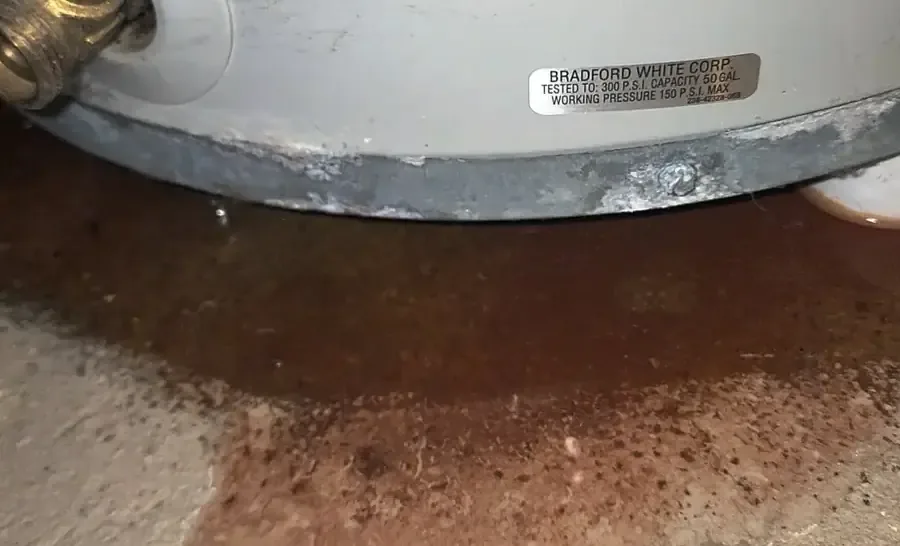
A tank-style water heater holds 40 to 80 gallons and refills as fast as it leaks. In a split-level or a finished basement, the utility room usually shares a wall with a carpeted family room or a bedroom, so water reaches finished space quickly.
How water heaters fail
Tanks rust from the inside as the anode rod wears out, and minerals settle in the bottom of the tank. Hard water speeds that up, which is why so many homes here also run a water softener. Fittings, the relief valve and the drain valve can leak long before the tank itself gives out.
- Tank corrosion at the bottom seam
- Temperature and pressure relief valve discharge
- Leaking drain valves and inlet or outlet fittings
- Failed expansion tanks and connectors
Water that spreads under walls
Water from the utility room runs under the bottom plate into the next room and wicks into carpet pad and drywall. The tech who does the walkthrough maps every wall that shares the utility room floor. Clean water caught early can often be dried in place; water that sat for days or mixed with dirt may be treated as Category 2.
Drying and the replacement
The extraction crew removes the water, pulls wet pad and vents or cuts wall bottoms, then sets air movers and LGR dehumidifiers. A plumber replaces the heater. EPA WaterSense has tips on water use and leaks, and the Minnesota Department of Labor and Industry oversees plumbing and fuel gas installation in the state.