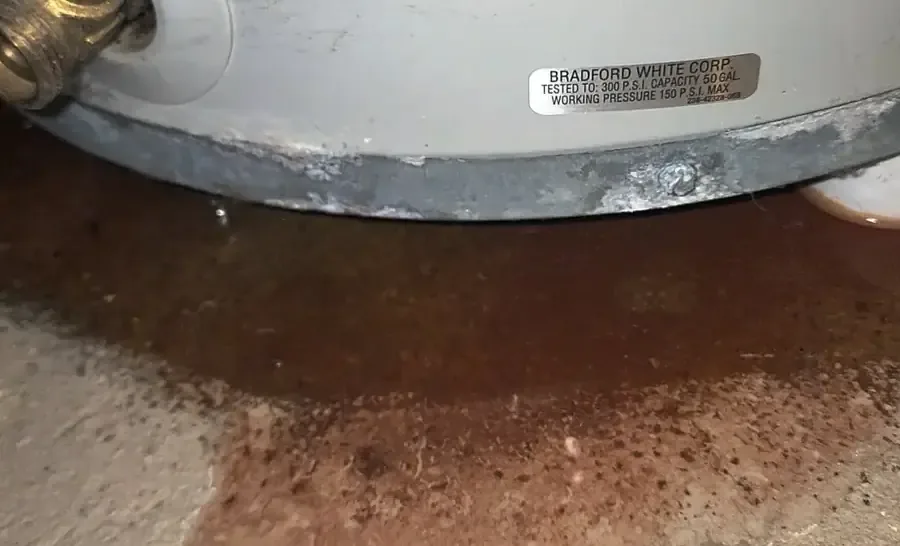
A full water heater tank holds dozens of gallons, and when the tank fails it can empty into a finished lower level in a short time. In Shakopee, a water heater in a finished basement is a known failure point.
Key takeaways
- Shutting off the cold water supply to the tank and the power or gas stops the leak from continuing.
- A leaking tank is replaced, not repaired, so the drying can run alongside the replacement.
- Carpet pad, drywall bottoms, baseboard and framing wick tank water faster than most owners expect.
- Clean tank water is the best case, but it can degrade if it sits.
- Water softeners and washer hoses often share the room, so every connection nearby gets checked.
What a tank leak does to a finished lower level
A leak from a tank may start as a drip and become a flood when a seam or a fitting gives way. In a finished space the water has a lot to soak.
Newer split-levels and townhomes often have a carpeted lower level with drywall walls and a utility closet beside the tank.
A tank past its prime is the usual culprit, and corrosion near the bottom is a common starting point.
- Carpet and pad soak first and hold water against the slab
- Drywall wicks upward from the floor and can wet a foot or more of wall
- Baseboard and trim swell and can trap water behind them
- Framing and bottom plates take on water through the drywall
- Cabinets and furniture legs absorb water from the floor
The first steps: shut off water and power
The goal is to stop the source and keep people safe. A short sequence does most of the work.
Before anyone steps in
Check the floor before walking across it. Wet concrete near a plugged in dehumidifier, freezer or the tank itself is a shock risk.
Switch off the circuit before touching anything electrical.
Stop the water
Close the cold water supply valve to the tank, usually on the pipe above it. If the valve is stuck or the leak is large, close the main water valve for the house.
Stop the power or gas
For an electric tank, turn off the breaker for that circuit. For a gas tank, set the gas control to off.
Do not step into standing water near the tank or the panel until the power to that room is off.
What stays and what comes out
Water from a tank starts clean, so the cleanup can save more than it can after sewage or flood water.
That changes if the water sits. Clean water that stays in carpet and pad can turn into something that needs stricter handling.
Timing matters here. Carpet lifted and dried quickly has a far better chance than carpet left in place overnight.
- Carpet may be saved if it is lifted and dried quickly, but pad is usually removed
- Drywall that stayed wet is cut back past the wet edge
- Baseboard is often removed so the wall can be opened at the bottom
- Hard flooring is checked for water underneath before it is declared safe
- Items on the floor are lifted and dried, or discarded if they cannot be saved
Drying behind finished walls
The surface is only part of the problem. Water travels into wall bays and under floors, where nothing shows.
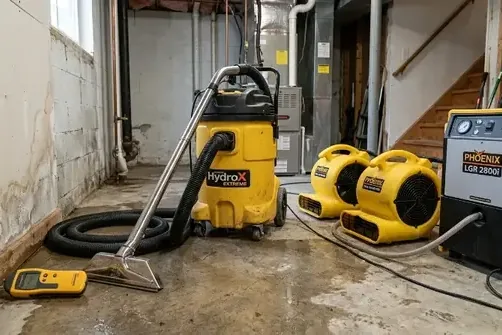
Structural drying uses air movers, dehumidifiers and moisture readings to reach the hidden water.
Opening the wall
Small openings along the bottom of a wall let dry air reach the cavity. In some cases the drywall has to come off to the first dry stud.
Readings at several heights show how far the water went.
Knowing when to stop
Drying ends when readings come back normal, not after a set number of days.
Damp materials can start growing mold within 24 to 48 hours, so the work begins as soon as the standing water is out.
Other connections near the tank
A water heater rarely sits alone. In a finished lower level it often shares the room with a water softener, a washer and a utility sink.
Washer hoses and softener connections are common failure points, so each one gets checked when a tank leaks. The appliance leak water damage service covers the leaks that start at those connections.
- Look at the supply hoses behind the washer for bulges and wet spots
- Check the softener connections and the drain hose for drips
- Open the utility sink cabinet and look for wetness along the back
- Look at the floor drain, if there is one, to see whether it is moving water
Mistakes that make a tank leak worse
Most of the extra damage after a tank leak comes from waiting.
A few habits are worth dropping in the first hour:
- Waiting to see whether the leak stops on its own
- Leaving wet carpet and pad in place overnight
- Using a household vacuum on standing water
- Stacking boxes against a wet wall, which blocks air from reaching it
- Closing the room off with no airflow while the water sits
Replacing the tank while the drying goes on
A tank that has leaked from the body is replaced, not patched. That is a plumbing job, and it can run in parallel with the drying.
The water heater leak cleanup team handles the wet materials and the drying, and the plumber handles the tank.
A leak caught early is a smaller job, so it is worth looking at the tank base and the floor around it once a month.
- Photograph the tank, the label and the leak before it is removed
- Keep the old tank until the leak source has been recorded
- Ask the plumber to check the drain pan, the relief pipe and the shutoff valve
- Confirm the new tank has a clear path for water to drain, if it ever leaks again
Questions
What should be done first when a water heater leaks?
Close the cold water supply valve to the tank, turn off the breaker or set the gas control to off, stay out of standing water until the power is off, and photograph the leak and the damage.
Can a leaking water heater be repaired?
When the leak comes from the tank body, the tank is replaced. Leaks at fittings, valves or connections can sometimes be fixed without replacing the tank.
Is water from a water heater tank clean?
It starts out clean, which is the best case. If it sits in carpet, pad or drywall for long, it can degrade and need stricter handling.
What gets removed after a tank leak?
Pad, wet drywall past the wet edge and often baseboard. Carpet and hard flooring may be saved if they are lifted and dried quickly.
Why are the washer and softener checked too?
They often share the room, and their hoses and connections are common failure points. A tank leak can hide a second source.
How long does drying take after a tank leak?
There is no fixed number. Readings in the walls and floor decide, and the equipment stays until they come back normal.