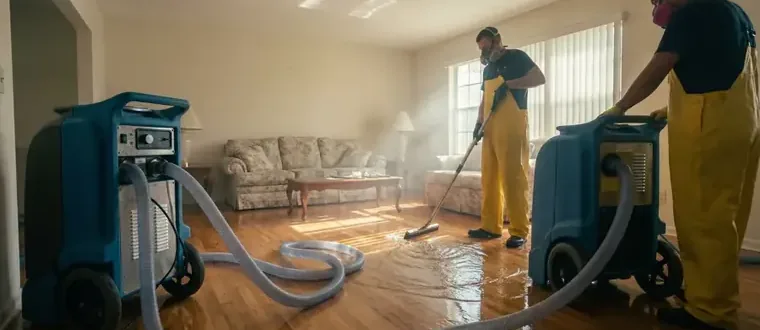
Drying equipment and monitoring

Structural Drying in Chanhassen, MN

Once the standing water is gone, the walls, floors and framing are still holding moisture. The drying crew places dehumidifiers and air movers, logs the readings each day and stops only when every material is dry.

(888) 432-4933Call the drying crew
LGR dehumidifiers Air movers sized to the room Psychrometric logs
Air movers and dehumidifiers drying a room after water damage in Chanhassen
EquipmentLGR units and air movers
Heavy jobsDesiccant and heat
MonitoringDaily moisture and air logs
FinishDry reference readings
Right now

First steps for structural drying and dehumidification

  1. Keep doors closed

    Close the rooms being dried so the dehumidifiers treat only that air.

  2. Leave equipment running

    Do not unplug or move the machines, as each is placed on purpose.

  3. Raise the thermostat

    Warm air holds more moisture and speeds drying.

  4. Note the noise

    Fans and units run for days, but the readings decide when they stop.

Trade facts
Class of loss1 to 4, by material and area
EquipmentLGR, air movers, desiccant
ReadingsDaily, with logs kept
Done whenMaterials reach dry standard
The standard

How structural drying and dehumidification is held to the drying standard

Rapid local response

Active water is treated as urgent at any hour, because it keeps wicking into drywall, pad and framing after dark.

IICRC S500 drying standard

Structural drying, not just surface drying, with equipment sized to the class of the loss.

Claim-ready documentation

A moisture map, daily psychrometric readings and timestamped photos taken before any demolition.

Cold-climate know-how

Basements, frozen pipes, ice dams and spring thaw water are everyday work in the Minnesota River valley.

Typical cost ranges

What does structural drying and dehumidification cost in Chanhassen, MN?

Structural drying here runs from about $1,000 for a small area to $8,000 or more for dense materials. The number of rooms, the types of materials and how many days the equipment runs set the price.

Class 1 or 2, one area

$1,000 to $2,500
  • A few air movers
  • One LGR dehumidifier
  • Daily readings

Several rooms or a level

$2,500 to $5,000
  • Multiple LGR units
  • Wall and floor drying
  • Psychrometric logs

Class 4, dense materials

$5,000 to $8,000+
  • Desiccant drying
  • Hardwood mats or heat
  • Extended monitoring

Ranges are typical, not a quote. The water category, the square footage that got wet, the material class and how fast drying started move the number most. For a planning range, run the water damage cost calculator.

The process

The structural drying and dehumidification process, in order

The order matters: moisture mapping comes before equipment, and equipment stays until the readings say dry, not until it looks dry.

  1. 01

    Classify

    Meters and thermal imaging set the class of loss.

  2. 02

    Place the equipment

    Dehumidifiers and air movers are sized to the room.

  3. 03

    Read each day

    Humidity and moisture are logged and the gear is moved.

  4. 04

    Confirm dry

    Equipment comes out when readings meet the dry standard.

A floor that feels dry can still hold water in the subfloor, the bottom plate and the back of the drywall. Structural drying removes that moisture with air and heat, and it is measured with meters rather than judged by touch.

Why lower levels need care

In February 2011 sewage backed into about two dozen basements along Lake Susan Drive and a nearby street after a crack in a city water main, and most of those homes had finished lower levels. Carpets, lower walls and furnaces were ruined, a reminder of how much material a finished basement holds that cannot simply be dried in place.

How the equipment is chosen

The crew classifies the loss by how much water the materials took on, then sizes the equipment to the volume of air and the wet surface area. Dense materials such as hardwood, plaster or concrete call for more heat or desiccant units.

  • LGR dehumidifiers to pull moisture from the air
  • Air movers set along walls and across floors
  • Heat and mats for dense flooring

Daily monitoring and sign-off

Each visit records temperature, humidity and material moisture, so equipment is moved or removed as readings fall. A project that began with a flooded basement or with water extraction usually moves straight into this stage.

Equipment placement changes as the building dries. Units that start in the wettest corner move out as readings fall, which keeps the cost of the drying lower.

Service area

Structural drying and dehumidification across Chanhassen and nearby towns

Service area map

Drying equipment goes into homes and buildings across the city, from the older streets near the old village center to neighborhoods around Lake Susan, Lake Lucy, Carver Beach and the Bluff Creek area. Any wet level can be dried this way.

The same service nearby: structural drying and dehumidification in Shakopee, Chaska, Victoria.

Water damage restoration in Chanhassen · every town covered

Questions

Structural Drying and Dehumidification questions in Chanhassen, MN

Why does drying take several days?

Wood, concrete and drywall release water slowly, so the equipment has to keep moving the moisture out until readings fall to the dry reference. Rushing the end only leaves damp framing behind.

Is the noise and heat normal?

Yes. Dehumidifiers and air movers run constantly and add warmth, which helps materials give up moisture.

Can wet drywall be saved?

Sometimes. Clean-water drywall that has not swelled can often be dried in place, while contaminated or swollen sections are removed.

How is dry measured?

With moisture meters and humidity readings, compared with an unaffected area of the same material, and recorded in the daily log.

What does the log show?

Temperature, humidity and moisture in each wet material, so the drying can be proven and the equipment removed at the right moment.

24/7 water removal

Dry the structure, not just the surface

Share what was wet and for how long, and the crew will size the equipment, log the readings and stay until the materials are dry.

(888) 432-4933Plan the drying
Call (888) 432-4933 24/7