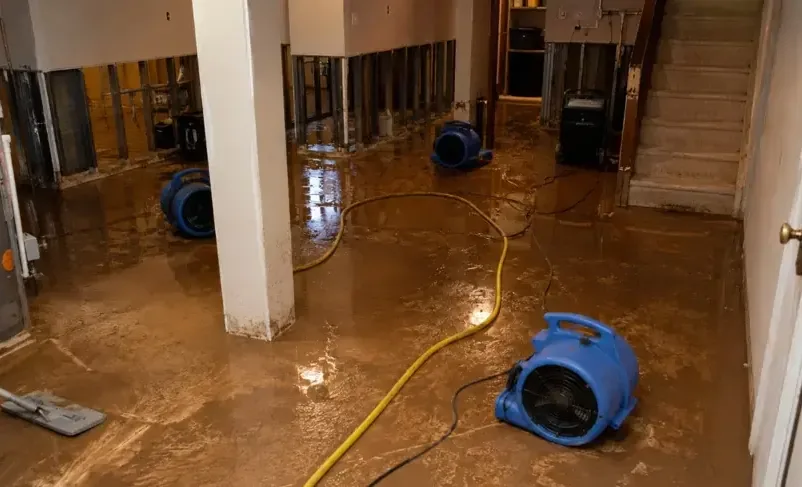
Lower levels under water

Basement Flooding Cleanup in Victoria, MN

A flooded lower level can hide wet insulation, framing and concrete long after the surface looks dry. The crew pumps the water out, removes what cannot be saved, and dries the rest to a measured finish.

(888) 432-4933Get a basement pump-out crew moving
Pump-out and extraction Flood cuts above the water mark Daily moisture readings
Victoria basement flooding: standing water across a finished basement floor
Typical scopePump-out, cuts, drying
Water markCuts go above it
ConcreteSlow to dry, tracked daily
Finish pointDry readings, not dates
Right now

First steps for basement flooding cleanup

  1. Mind the power

    Stay off the stairs if water touches outlets or the panel; leave power to an electrician.

  2. Move valuables up

    Raise boxes and rugs onto shelves, and keep small children and pets upstairs.

  3. Mark the water

    Photograph the water mark on walls and wet belongings before anything moves.

  4. Start the pump-out

    Hold off on scrubbing; the crew removes the volume first to protect framing.

Trade facts
Water category1 to 3, set by the source
CutsFlood cuts above the water mark
InsulationWet batts pulled on outside walls
Dry targetSlab and studs at dry readings
The standard

How basement flooding cleanup is held to the drying standard

Rapid local response

Active water is treated as urgent at any hour, because it keeps wicking into drywall, pad and framing after dark.

IICRC S500 drying standard

Structural drying, not just surface drying, with equipment sized to the class of the loss.

Claim-ready documentation

A moisture map, daily psychrometric readings and timestamped photos taken before any demolition.

Cold-climate know-how

Basements, frozen pipes, ice dams and spring thaw water are everyday work in the Minnesota River valley.

Typical cost ranges

What does basement flooding cleanup cost in Victoria, MN?

Basement jobs here run from about $2,500 for an unfinished space to $12,000 or more for contaminated or whole-level flooding. Finishes, insulation and the water category change the total most, and a written scope follows the readings.

Unfinished, or partly done

$2,500 to $4,500
  • Pump-out, extraction
  • Slab and wall drying
  • Readings each visit

Finished lower level

$4,500 to $8,500
  • Carpet, pad and flood cuts
  • Insulation out on outside walls
  • Framing dried

Contaminated or whole level

$8,500 to $12,000+
  • Category 3 removal
  • Containment and antimicrobial
  • Extended drying

Ranges are typical, not a quote. The water category, the square footage that got wet, the material class and how fast drying started move the number most. For a planning range, run the water damage cost calculator.

The process

The basement flooding cleanup process, in order

The order matters: moisture mapping comes before equipment, and equipment stays until the readings say dry, not until it looks dry.

  1. 01

    Pump out

    Pumps and extractors remove standing water and silt from the floor.

  2. 02

    Cut and clear

    Wet carpet, pad, lower drywall and insulation are removed above the water mark.

  3. 03

    Dry the structure

    Dehumidifiers and air movers work on slab, studs and sill plates.

  4. 04

    Verify

    Readings repeat until each material reaches the dry standard.

Water collects in lower levels because everything runs downhill to them. In Victoria the crew treats the pump-out, the removals and the drying as one plan, so nothing stays wet behind a finished wall. Pumping comes first, since a slab covered in water cannot start drying.

What the 2014 lake flood showed

A 2015 Minnehaha Creek Watershed District study counted 16 property owners affected when Lake Zumbra peaked in July 2014, and five of them had water above the lowest opening. That gap matters, because a puddle on a slab and a flooded finished room need very different work. A May 2019 newspaper report said no Zumbra Ridge homes flooded despite rain above 2014 levels, which the mayor credited to dredging the outlet canal.

  • Standing water and silt pumped out before anything is lifted
  • Wet carpet, pad and lower drywall removed above the water mark
  • Concrete, studs and sill plates dried until readings settle

Finished versus unfinished space

An unfinished utility area may need only extraction and a few days of dehumidification. A finished lower level with carpet, drywall and insulation behind it needs flood cuts, removal of wet insulation on outside walls, and drying of the framing before rebuilding is even discussed. Exterior walls get the most attention, because wet insulation there stays wet for weeks if left in place.

Why basements dry slowly

Concrete holds water and releases it slowly, and a cool basement slows evaporation further. Low-grain dehumidifiers, heat and steady airflow bring readings down, and the crew logs them at each visit. See water extraction for the pump-out stage and structural drying for the equipment side. Rushing the rebuild over damp concrete traps moisture beneath new flooring.

Service area

Basement flooding cleanup across Victoria and nearby towns

Service area map

Basement work covers the lake streets around Lake Zumbra, newer neighborhoods such as Huntersbrook and Brookmoore, the older blocks near Stieger Lake and Bayfront Park, and Zumbra Ridge and the pond-side streets near Kelzer Pond, across ZIP 55386.

The same service nearby: basement flooding cleanup in Shakopee, Chaska, Chanhassen.

Water damage restoration in Victoria · every town covered

Questions

Basement Flooding Cleanup questions in Victoria, MN

Does lake high water mean groundwater in the basement?

It can. High lake levels and saturated ground push water toward foundations, and the 2015 study said Lake Zumbra peaks about 7 days after big rains, so seepage can show up late.

Which materials come out after a basement flood?

Carpet and pad, drywall below the water mark, wet insulation and anything porous touched by contaminated water. Concrete, studs and plates are dried and kept.

Why do flood cuts go above the water mark?

Drywall wicks moisture upward past the visible stain, so the cut sits a little higher, letting the cavity dry and the framing be inspected.

How long before a finished basement can be rebuilt?

After slab, studs and plates reach the dry standard, usually after several days of equipment, though dense materials can take longer.

Is a flooded basement always category 3?

No. Clean supply water starts as category 1, groundwater and washer overflow are category 2 or worse, and lake, storm or sewer water is category 3. Source and time decide it.

What should be saved before the crew arrives?

Photos of the damage, a list of wet belongings and any receipts. Valuables can move upstairs, but heavy carpet and wet furniture can wait for the crew.

24/7 water removal

Basement under water? Begin the pump-out.

Share how deep the water is and whether the lower level is finished, and the crew builds the removal and drying plan from that.

(888) 432-4933Start the basement cleanup
Call (888) 432-4933 24/7