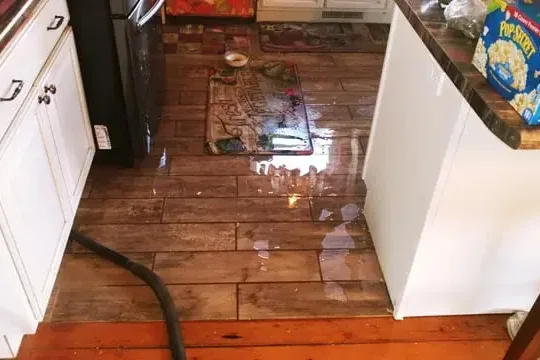
Removing liquid water is the fastest way to limit a loss, and it has to happen before any drying equipment can do its job. Victoria properties need it after lake-area storms, stalled pit pumps and failed supply hoses. Pad, baseboards and drywall edges begin to wick moisture upward almost immediately.
Why extraction comes first
Air movers and dehumidifiers work on moisture held inside materials, not on pooled water. When a basement or kitchen still holds a puddle, the equipment spends days fighting it. The 2014 high water on Lake Zumbra put surface water and wet basements along Zumbra Drive and Zumbra Circle, according to the watershed district's 2015 study, and removal had to start with that volume. Pumping also keeps the water from creeping into rooms that were still dry.
- Wand tools for carpet, pad and tight corners
- Truck-mounted units for large floor areas
- Submersible pumps for deep standing water
Water type decides the method
Clean supply water can often be extracted and the carpet saved, as long as it is caught early. Gray water from a washer or dishwasher needs more caution, and black water from sewage or lake overflow means porous materials are removed and discarded. The crew tests the situation and explains which path applies before any pad is cut. Category 1 water that sits for a day or two can slip into category 2.
What happens after the water is gone
Extraction is only the first half. The crew lifts carpet edges, probes wall bottoms and maps moisture with meters and a thermal camera, since water travels under flooring and into drywall well past the wet patch. Photos and readings from this stage go into the claim file. That map sets the drying plan, and structural drying takes over from there. Larger losses continue as basement flooding cleanup.