Lower level flooding

Basement Flooding Cleanup in Chaska, MN

Lower levels collect water from the foundation, the sump pit and the drains. The cleanup crew pumps out the depth, strips what stayed wet and dries the concrete and framing until readings say stop.

(888) 432-4933Get the basement pumped out
Pump-out and extraction Wet material removed Concrete and framing dried
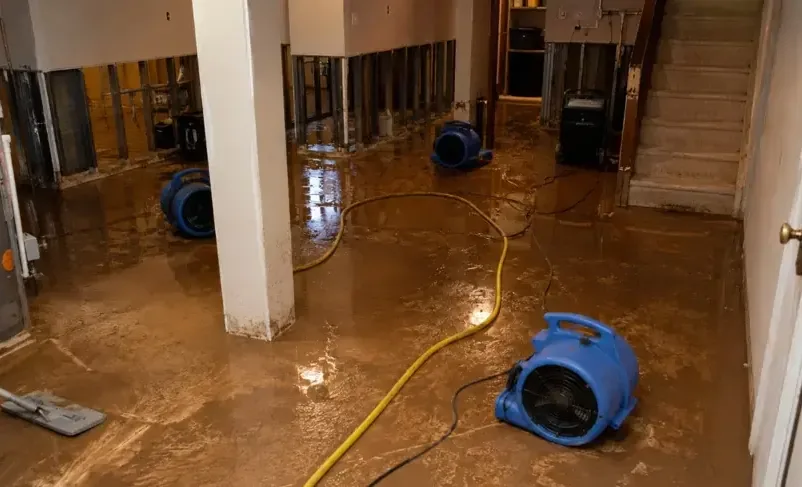
Chaska basement flooding: standing water across a basement floor
Water sourceGround, drain or pipe
DepthPumped out first
FinishesCut above the water mark
DryingConcrete, block and framing
Right now

First steps for basement flooding cleanup

  1. Stay off wet floors

    Skip the basement if water is near outlets, and cut power from a dry spot.

  2. Move valuables up

    Lift boxes, electronics and papers to a dry level before the water climbs.

  3. Keep the sump running

    If the pump still works and the power is safe, let it drain the pit.

  4. Photograph the water mark

    The wall height shows how far removal must reach.

Trade facts
Water category2 or 3, set by the source
Cut heightAbove the highest water mark
Surfaces driedConcrete, block and framing
RecordsDaily moisture readings
The standard

How basement flooding cleanup is held to the drying standard

Rapid local response

Active water is treated as urgent at any hour, because it keeps wicking into drywall, pad and framing after dark.

IICRC S500 drying standard

Structural drying, not just surface drying, with equipment sized to the class of the loss.

Claim-ready documentation

A moisture map, daily psychrometric readings and timestamped photos taken before any demolition.

Cold-climate know-how

Basements, frozen pipes, ice dams and spring thaw water are everyday work in the Minnesota River valley.

Typical cost ranges

What does basement flooding cleanup cost in Chaska, MN?

A basement job here ranges widely because the scope follows how much was finished and whether the water was clean and how long it sat. The cards show typical ranges for bare, finished and contaminated lower levels.

Bare or partly finished

$2,500 to $4,500
  • Water pumped and extracted
  • Slab and walls dried
  • Readings each visit

Finished lower level

$4,500 to $8,500
  • Carpet, pad and flood cuts
  • Outside wall insulation out
  • Studs dried in place

Contaminated or whole level

$8,500 to $12,000+
  • Category 3 material removal
  • Containment with antimicrobial
  • Drying extended

Ranges are typical, not a quote. The water category, the square footage that got wet, the material class and how fast drying started move the number most. For a planning range, run the water damage cost calculator.

The process

The basement flooding cleanup process, in order

The order matters: moisture mapping comes before equipment, and equipment stays until the readings say dry, not until it looks dry.

  1. 01

    Pump it out

    Submersible pumps and extraction units clear the standing depth.

  2. 02

    Strip the wet finishes

    Carpet, pad and low drywall come out at the wet height.

  3. 03

    Treat and dry

    Antimicrobial goes on framing, then heat and dehumidifiers run.

  4. 04

    Verify dry

    Readings on the slab and studs must match the dry standard.

Many of the oldest homes in the lower part of Chaska date to the 1850s, and much of that housing once sat in the Minnesota River floodplain, under rebuilding limits that ended when the 1998 flood control project was completed. Water in a lower level here deserves a close look at where it actually came from.

What a flooded lower level needs

The cleanup crew pumps out the depth first, then cuts away whatever stayed wet. Wicking carries water above the visible mark, so removal usually reaches higher than the stain. Rooms are opened section by section so nothing hidden behind a wall is missed.

  • Carpet and pad are lifted and hauled out when they sat in water
  • Drywall is cut a few inches above the highest wet reading
  • Insulation on outside walls comes out because it holds water
  • Concrete and block stay in place and are dried with heat and dehumidifiers

Older and newer lower levels side by side

A 2007 city plan estimate placed about 30 percent of local housing as built before 1980 and about 9 percent before 1960, with a large share added from 2000 to 2007. Homes from different decades share the same streets, so the crew reads each lower level on its own terms instead of assuming how it was built.

Drying concrete, block and framing

Concrete and block release moisture slowly, and a cold lower level slows it further. Heated air, low-grain dehumidifiers and airflow along the walls, the core of structural drying, bring readings down, with checks repeated until the slab and the framing meet the dry standard. A lower level can feel dry on the surface long before the slab and the sill plates are, so the crew trusts the meter over the touch.

Service area

Basement flooding cleanup across Chaska and nearby towns

Service area map

Basements and lower levels are covered across the whole city, from the older blocks near downtown to Jonathan, Clover Ridge, the lake neighborhoods and newer subdivisions, day or night, in every season of the year.

The same service nearby: basement flooding cleanup in Shakopee, Chanhassen, Victoria.

Water damage restoration in Chaska · every town covered

Questions

Basement Flooding Cleanup questions in Chaska, MN

Why does a basement flood after heavy rain?

Saturated ground pushes water through cracks, joints and window wells, and a pump that cannot keep up lets the pit overflow. Drain backups are the other common route.

How high should wet drywall be cut?

A few inches above the highest wet reading, since moisture wicks upward past the visible stain. The exact height comes from the meter rather than a guess.

Does finished space change the plan?

It adds material to remove and rebuild, but the steps stay the same: pump, strip, treat and dry.

Can a concrete slab be dried?

Yes. It dries slowly, so heated air and dehumidifiers run for days while readings are logged until the slab meets its target.

What if the water came from a drain?

Drain water is treated as sewage, with containment and disposal. Sewage backup cleanup covers that case.

Will belongings be moved?

Contents in the wet area are lifted, photographed and stored dry or set aside for the adjuster, and nothing porous that sat in sewage returns to the room.

24/7 water removal

Water in the lower level tonight?

Describe how high the water reached and what is down there, and the crew will explain what removal and drying will involve.

(888) 432-4933Describe the flooding
Call (888) 432-4933 24/7