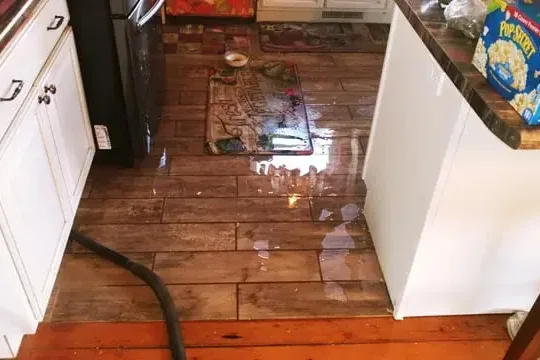
Standing water removal

Water Extraction in Prior Lake, MN

Lake rise, a failed city main or a split pipe indoors can leave water standing across a floor, and extraction crews pull it out with truck-mounted units and wands before it wicks into walls and framing.

(888) 432-4933Request pumps for standing water
Truck-mounted extractors Pumps for deep water Moisture mapping
Prior Lake water extraction: hose pulling standing water off a kitchen floor
Water typesClean, gray or black
Main toolsTruck-mounted extractor, pump, wand
SurfacesCarpet, pad, tile, hardwood, subfloor
Followed byMoisture map and drying plan
Right now

First steps for water extraction and removal

  1. Stop the source

    Shut the main valve or the supply to the failed fixture if it is safe to reach.

  2. Keep power away

    Leave wet outlets and cords alone, and cut the breaker from a dry spot only.

  3. Lift what you can

    Move rugs, boxes and small furniture onto dry ground or blocks.

  4. Take photos

    Capture the water, the damage and the contents before anything is pumped or moved.

Trade facts
EquipmentTruck-mounted extractor, pumps, wands
Carpet and padFloated, lifted or removed by condition
Protective gearGloves, boots and respirators for dirty water
HandoffExtraction readings, then a drying plan
The standard

How water extraction and removal is held to the drying standard

Rapid local response

Active water is treated as urgent at any hour, because it keeps wicking into drywall, pad and framing after dark.

IICRC S500 drying standard

Structural drying, not just surface drying, with equipment sized to the class of the loss.

Claim-ready documentation

A moisture map, daily psychrometric readings and timestamped photos taken before any demolition.

Cold-climate know-how

Basements, frozen pipes, ice dams and spring thaw water are everyday work in the Minnesota River valley.

Typical cost ranges

What does water extraction and removal cost in Prior Lake, MN?

Extraction alone usually costs between $500 and $3,500 here, depending on how many rooms are wet, how deep the water got and whether it was clean or contaminated. Drying and repairs are priced separately.

One room, clean water

$500 to $1,200
  • Wand extraction of the floor
  • Carpet lifted and floated
  • Soaked pad cut and removed

Several rooms or a lower level

$1,200 to $2,500
  • Truck-mounted extraction
  • Pumps for standing water
  • Moisture map of the floors

Deep or dirty water

$2,500 to $3,500+
  • Submersible pumps
  • Category 3 handling
  • Carpet and pad hauled away

Ranges are typical, not a quote. The water category, the square footage that got wet, the material class and how fast drying started move the number most. For a planning range, run the water damage cost calculator.

The process

The water extraction and removal process, in order

The order matters: moisture mapping comes before equipment, and equipment stays until the readings say dry, not until it looks dry.

  1. 01

    Find the water

    Meters and a thermal camera show where it traveled.

  2. 02

    Pull it out

    Truck-mounted units and pumps remove the bulk, and wands finish the edges.

  3. 03

    Open what holds it

    Soaked pad and wall bottoms are lifted or vented so water can leave.

  4. 04

    Hand off to drying

    A moisture map sets the dehumidifier and air mover plan.

Standing water in a Prior Lake home can come from the lake, a city main or a failure indoors, and the extraction crew treats all three the same way: get the bulk out fast, then find what soaked in.

Where the water comes from

The 2014 flood lifted the lake 6 feet, and a six-inch main on Green Heights Trail sent a foot of water into one basement in February 2019. Indoors, a split hose or a failed tank does the same job on a smaller scale. The source matters because it sets the water category, which decides what can be saved. Water also travels, moving under baseboards, through floor cracks and down to the level below, so the crew checks well beyond the edge of the visible stain.

  • Clean water from supply pipes and appliances
  • Gray water from sump pumps and washers
  • Black water from sewage, lake overflow and floodwater

How the water comes out

Truck-mounted units handle large areas and carry the water outside through long hoses. Submersible pumps clear anything deep enough to float a cord. Hand wands finish edges, stairs and tight rooms. Carpet is lifted and floated off the pad when the pad can stay dry, and wet pad is cut out when it cannot. Speed matters because pad and wall bottoms begin absorbing at once and hardwood can start to cup within days. Both truck-mounted and portable equipment are on hand, so a stairwell or an upstairs room is no obstacle.

What happens after extraction

Extraction removes the bulk, but moisture stays in pad, subfloor, baseboards and wall bottoms. A meter and thermal camera trace what is still wet, and the crew sets up structural drying equipment to match. Skipping that step is how a dry-looking floor turns musty a week later.

Service area

Water extraction and removal across Prior Lake and nearby towns

Service area map

The extraction crew works across the whole city, from the Lakefront Park area and the shoreline neighborhoods to the County Road 21 corridor and the homes around Jeffers Pond, Grainwood Bay and Hickory Shores.

The same service nearby: water extraction and removal in Shakopee, Eden Prairie, Chaska.

Water damage restoration in Prior Lake · every town covered

Questions

Water Extraction and Removal questions in Prior Lake, MN

How fast does standing water need to come out?

As early as possible, because carpet pad, baseboards and wall bottoms keep absorbing while water sits. Early extraction often saves flooring that a delayed job would force out.

Can wet carpet be saved after extraction?

Often yes when the water was clean and the carpet is lifted and floated quickly. The pad usually cannot be saved, and carpet touched by sewage or floodwater is removed.

What is the difference between extraction and drying?

Extraction removes liquid water with pumps and vacuums. Drying pulls the moisture that stays in materials, using dehumidifiers and air movers, and it takes days rather than hours.

Does the source of the water change the job?

Yes. Clean supply water, gray water from a failed pump and black water from sewage or floodwater need different handling, and the category decides what is removed and what is cleaned.

Will extraction be enough on its own?

Rarely. Surface water is only part of the loss, so a meter reading follows extraction and the crew sets drying equipment for whatever stays wet inside materials.

24/7 water removal

Standing water is a clock, not a puddle

Describe the room, the depth and the source, and the crew builds the extraction and drying plan around that.

(888) 432-4933Start the pump-out plan
Call (888) 432-4933 24/7