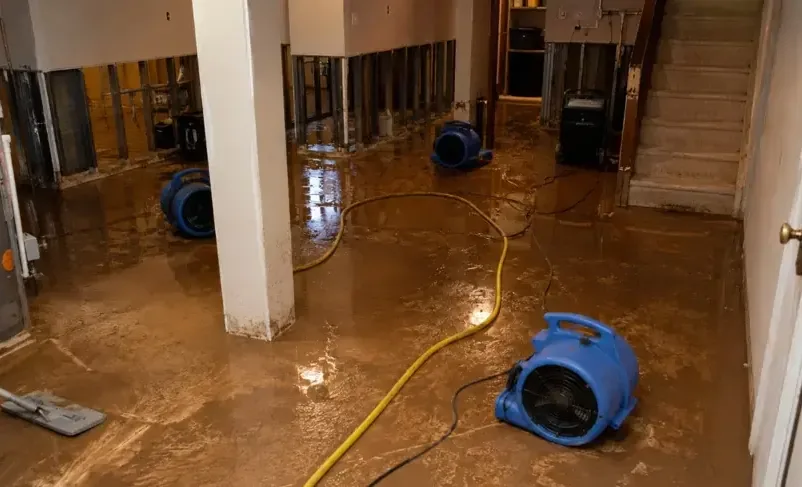
Most basement floods are fought from the bottom up: water first, then the carpet and pad it soaked, then the lower drywall and the framing behind it. The order matters, and so does how long each layer stays wet.
Why basements flood here
The city says water service enters most homes through the basement, near the meter, so a failed fitting or a broken main puts water right where the lower level sits. In February 2019 a main on Green Heights Trail broke and flooded nearby basements. Lake rise, heavy rain and a failed pump finish the list. When the ground around a foundation stays saturated, water also pushes through the floor joint and wall cracks after the rain has stopped, so a basement can stay wet for days.
What comes out and what stays
Clean water from a supply pipe often allows carpet to be lifted and dried. Anything touched by sewage or floodwater is different, and porous materials go to the curb.
- Carpet and pad that sat in dirty water
- Drywall and insulation wicked above the water mark
- Trim and cabinet kicks that swell or delaminate
Drying a lower level
Concrete holds moisture long after the surface looks dry, and cool basement air slows evaporation. Low-grain dehumidifiers, air movers and sometimes heat run until a meter on the floor, the wall bottoms and the framing matches a dry reference. Daily readings decide the finish day. Finished spaces dry slower than open ones, because carpet, pad, drywall and insulation trap moisture against the concrete and framing. Opening those layers lets air reach the surfaces, and it is the quickest route to a lower level that stays dry.